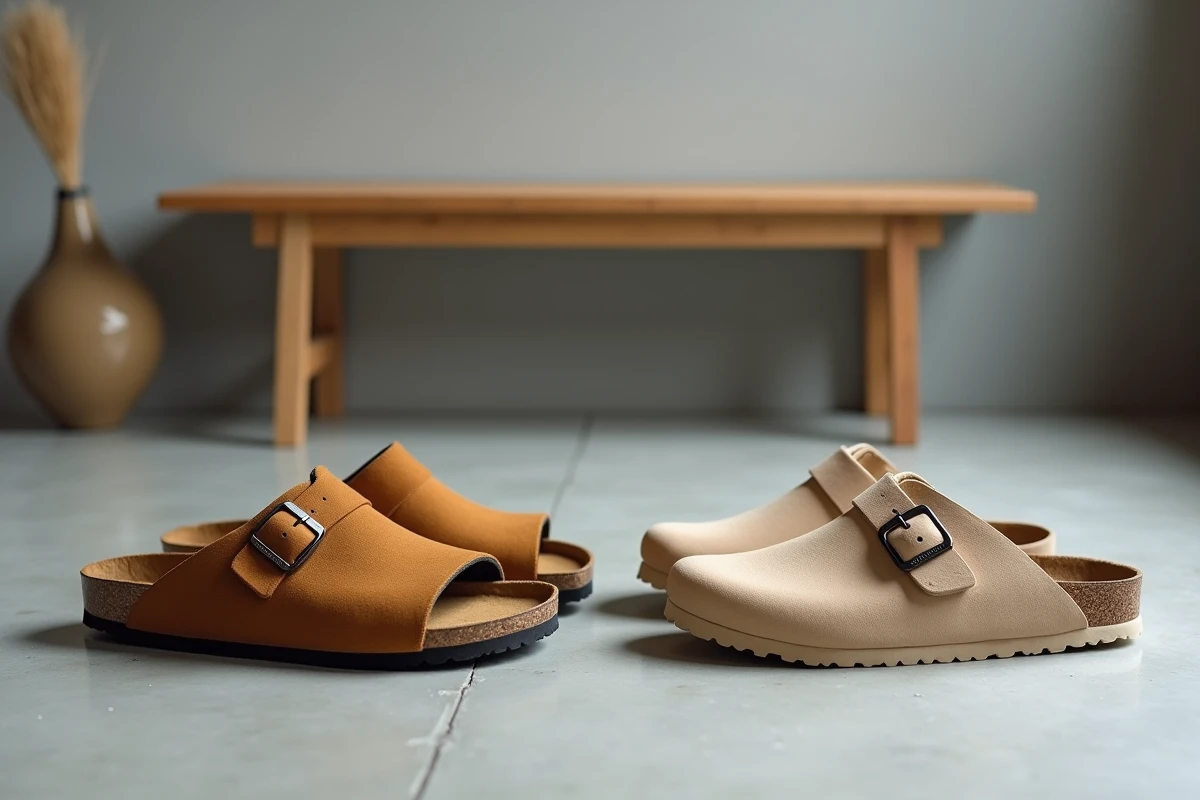
Scholl and Birkenstock occupy a similar niche in comfort-oriented footwear, but their technical approaches diverge on points that directly influence daily wear. Comparing these two brands is like opposing two philosophies of insoles, two types of materials, and two durability curves. This article measures these differences to identify what truly separates a Scholl model from a Birkenstock model in regular use.
Birkenstock cork sole vs Scholl foam sole: technical differences
| Criterion | Birkenstock | Scholl |
|---|---|---|
| Main sole material | Natural cork and latex | Synthetic foam (polyurethane or EVA depending on models) |
| Arch support | Rigid, molded anatomical arch | Soft padding, less structured |
| Immediate comfort (first fitting) | Firm, break-in period required | Soft from the first use |
| Material longevity | Cork densifies with use and retains its shape over several seasons | Foam tends to compress faster, reducing support |
| Softened sole option | Soft Footbed range (foam added on cork) | Not applicable (base foam) |
| Price positioning | Higher at purchase | Generally more accessible |
This table highlights a central trade-off: immediate comfort vs durability of foot support. Scholl offers a pleasant sensation right out of the box. Birkenstock requires a few days of adjustment before the cork molds to the shape of the foot.
A comparison between Scholl and Birkenstock shoes details these material differences and their implications for your profile.

Material durability: Birkenstock cork and Scholl foam after several months
The difference in feel between these two brands deepens over time. This is even the most discriminating point for anyone seeking long-term daily comfort.
Behavior of Birkenstock cork in use
The natural cork used by Birkenstock reacts to the pressure and heat of the foot. Over the weeks, it gradually molds to the individual morphology. Birkenstock cork densifies with use and retains its shape over several seasons, meaning that arch support remains stable well beyond the first year.
This behavior explains why many wearers describe an improvement in comfort over time, unlike a conventional shoe that degrades.
Behavior of Scholl foam in use
Synthetic foam offers immediate cushioning, but its cellular structure compresses under repeated weight. Scholl foam compresses more quickly, which gradually reduces arch support. For intensive daily use (prolonged standing, urban walking), this phenomenon can manifest within a few months.
However, for occasional or seasonal use, this wear remains barely noticeable.
Soft Footbed Birkenstock: the compromise between the two approaches
Birkenstock has developed a Soft Footbed range in recent years that deserves special attention in this comparison. Models like the Arizona Soft Footbed or the Zurich incorporate an additional layer of foam above the classic cork.
The result: a plush sensation similar to what Scholl offers from the first wear, combined with the structural support of cork underneath. This option significantly reduces the break-in period that deters some buyers from a classic Birkenstock model.
For those who find the traditional Birkenstock arch too firm but want to maintain durable support, the Soft Footbed serves as a documented middle ground according to several recent buying guides.
- Arch supported by cork, identical to classic Birkenstock models
- Surface foam layer that provides immediate cushioning without a break-in period
- Price slightly higher than standard versions, but lower than the price difference between two pairs of Scholl replaced in one season

Scholl or Birkenstock sandals for walking: active use and standing
The context of use weighs as much as the material in the choice between these two brands. Birkenstock has positioned itself in the walking and travel sandal segment, with models designed for prolonged active use. Lateral support, heel cup depth, and controlled rigidity of the sole contribute to foot stability during walking.
Scholl, historically oriented towards well-being and orthopedic insoles, prioritizes static comfort. Its models are suitable for home use, a day at the office, or short outings. For active walking, Birkenstock offers better structural support due to the rigidity of the cork that limits micromovements of the foot in the shoe.
This distinction does not disqualify Scholl. Both brands meet different needs:
- Prolonged urban walking, travel, standing for several hours: Birkenstock’s structure (cork, firm arch, deep heel cup) limits foot fatigue
- Home use, short outings, seeking lightness and immediate softness: Scholl foam fulfills its role without requiring a break-in period
- Mixed profile (immediate comfort and durability): the Soft Footbed Birkenstock range covers this middle ground
The choice between Scholl and Birkenstock is less about quality than about use and timing. Over a season, Scholl foam fully satisfies. Over several years of daily use, Birkenstock cork retains its supportive properties where foam will have lost a significant part of its support. The Soft Footbed Birkenstock now blurs this boundary by offering immediate comfort backed by a durable structure.