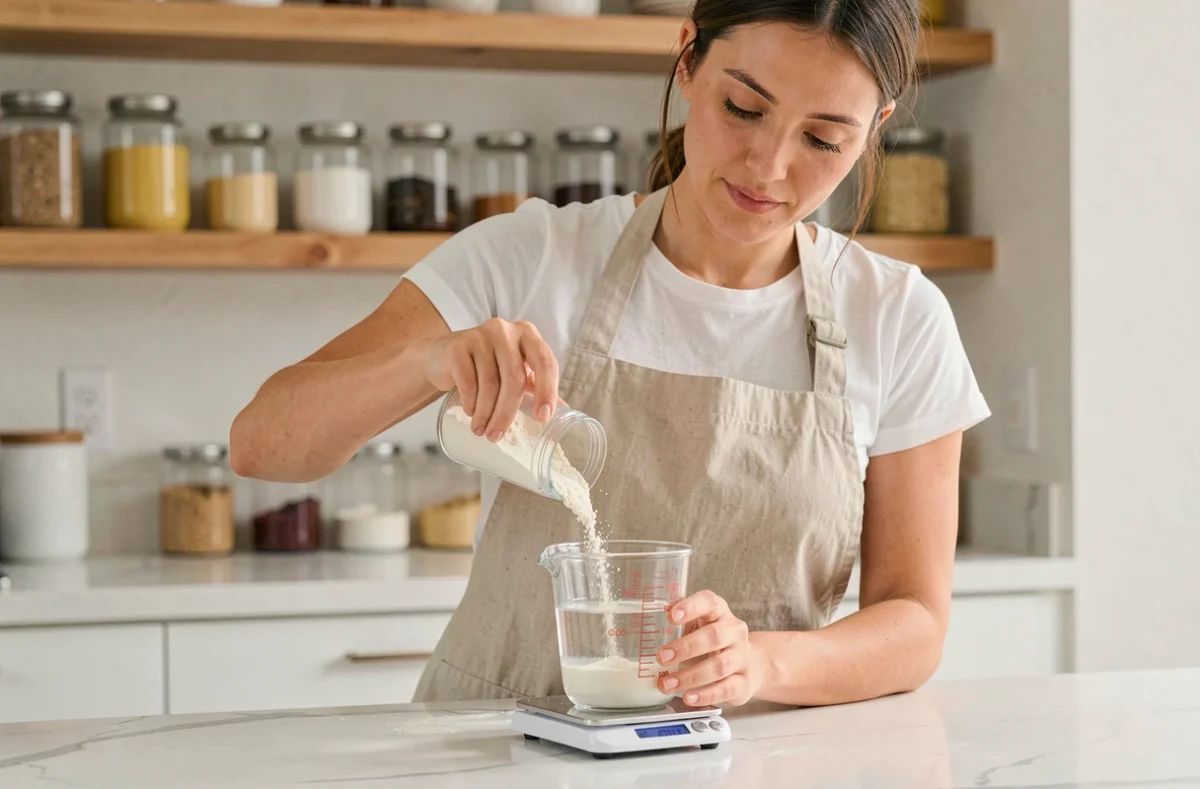
Converting grams to milliliters means converting a unit of mass into a unit of volume. For water, the ratio is straightforward: one gram equals one milliliter. For other ingredients, this equivalence no longer holds because each substance has its own density. Understanding how this works lets you adapt a recipe without guesswork.
Density: the factor that changes everything when converting grams to milliliters
Density (or mass density) tells you how many grams one milliliter of a given ingredient weighs. Water is the reference point, with a density of 1 g/ml. Any ingredient that is lighter than water takes up more volume at the same weight, and vice versa.
Oil, for example, floats on water because it is less dense. So, for the same weight in grams, its volume in milliliters will be greater than water’s. Honey, on the other hand, is considerably heavier than water: the same weight of honey takes up less volume.
The conversion formula is simple: volume (ml) = mass (g) / density (g/ml). If an ingredient has a density of 0.9 g/ml, then 100 g of that ingredient is about 111 ml. For high-fat dairy products such as coconut milk, converting 300 g of coconut milk to ml requires knowing its specific density, which differs from that of water or regular milk.
Remembering the formula means you don’t have to rely on a fixed conversion chart. Once you know an ingredient’s density (often listed on the packaging or in technical data sheets), you can convert any quantity.

Flour, sugar, oil: practical conversions for common cooking ingredients
Recipes switch between grams, milliliters, spoons, and cups. A few reliable guidelines cover most situations in the kitchen.
Common liquids
For water and semi-skimmed milk, the 1 g = 1 ml conversion works reliably. Oil is lighter, so the same weight takes up more volume. Honey and glucose syrup are heavier than water, so their volume in milliliters is less than their weight in grams.
Powders and solids
Flour is the most misleading ingredient. Because it traps air, it is much less dense than water. A cup of flour weighs considerably less than a cup of water of the same capacity. Granulated sugar is more compact and falls somewhere in between. Melted butter has a density similar to oil.
| Ingredient | Approximate density | 100 g in ml (approx.) |
|---|---|---|
| Water / Milk | 1 g/ml | 100 ml |
| Vegetable oil | Less than 1 g/ml | More than 100 ml |
| Wheat flour | Well below 1 g/ml | Considerably more than 100 ml |
| Granulated sugar | Slightly less than 1 g/ml | A little more than 100 ml |
| Honey | More than 1 g/ml | Less than 100 ml |
This chart gives you a rough guide. For precision baking (macarons, choux pastry), a kitchen scale is still the most reliable tool.
Spoons, cups, and measuring jugs: how reliable are these measuring tools?
When you don’t have a scale, volume-measuring utensils can fill the gap. Their accuracy varies considerably.
- A teaspoon holds about 5 ml, and a tablespoon about 15 ml. The difference between a level and a heaped spoonful can double the amount of flour or powdered sugar, so whether a recipe specifies “level” or “heaped” matters.
- A standard US cup holds about 237 ml, while a metric cup (used in Australia and some French-language recipes) holds 250 ml. Check which cup measurement the recipe uses to avoid a significant difference in the final proportions.
- A standard kitchen glass holds about 200 ml, but drinking glasses vary too much to be a reliable measure. A clear, graduated measuring jug marked in milliliters is a better choice.
The pitfall of measuring flour by the cup
How you fill the cup affects the result just as much as the cup itself. Flour spooned into a cup and leveled off is not the same as flour scooped directly with the cup. Scooping directly compacts the powder, increasing the actual amount compared with what the recipe calls for.
For recipes where precision matters, weigh the ingredients. For a vinaigrette or seasoning, a spoon is more than adequate: a difference of a few grams won’t affect the result.
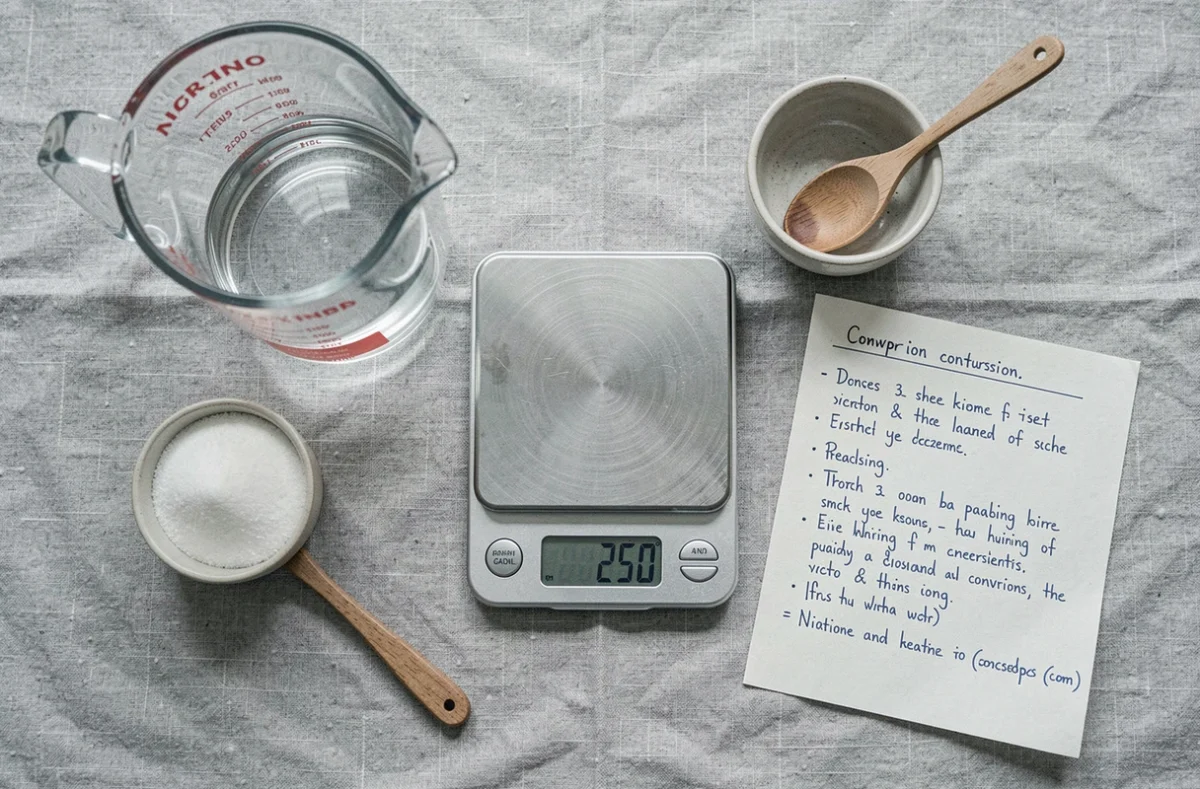
Adapting a foreign recipe: US cups and converting to grams
Recipes from the United States, Canada, or Australia list ingredients in cups and tablespoons. Converting these measurements to grams or milliliters requires two checks first.
First, identify the cup standard. The usual US cup and the “legal cup” used on some US nutrition labels do not hold exactly the same amount. The Australian metric cup is different too. Without checking, your conversion to milliliters may be off.
Second, account for the ingredient’s density. A cup of flour weighs nothing like a cup of sugar. Reliable conversion charts always specify the ingredient and how it should be measured. Two charts with different values are not necessarily contradictory: they may simply use different measuring conventions.
- For liquids (water, milk, juice), converting cups to ml is straightforward and does not depend on density.
- For powders (flour, cocoa, powdered sugar), converting cups to grams varies depending on how compacted the ingredient is and what type of product it is.
- For solid fats (butter, margarine), weighing directly in grams remains the most consistent method.
Kitchen scale or volume measurement: when precision really matters
A kitchen scale eliminates the need for conversion. Weighing ingredients directly in grams removes the uncertainties associated with volume, container shape, and how tightly an ingredient is packed.
The tare function is worth using: it lets you weigh several ingredients one after another in a single container, resetting the display to zero between each addition. This speeds up preparation and reduces washing up.
For everyday recipes (soups, sauces, pancakes), measuring by volume with spoons or a measuring jug works just fine. A scale becomes essential when a recipe depends on precise ratios: yeasted baking, confectionery, or bread dough. In these cases, a difference of a few grams of flour or yeast can change the final texture.
Converting grams to milliliters isn’t a matter of memorization. It’s a calculation based on a single factor—density—that applies to every ingredient. A reliable scale and a graduated measuring jug cover almost all the needs of a home kitchen.